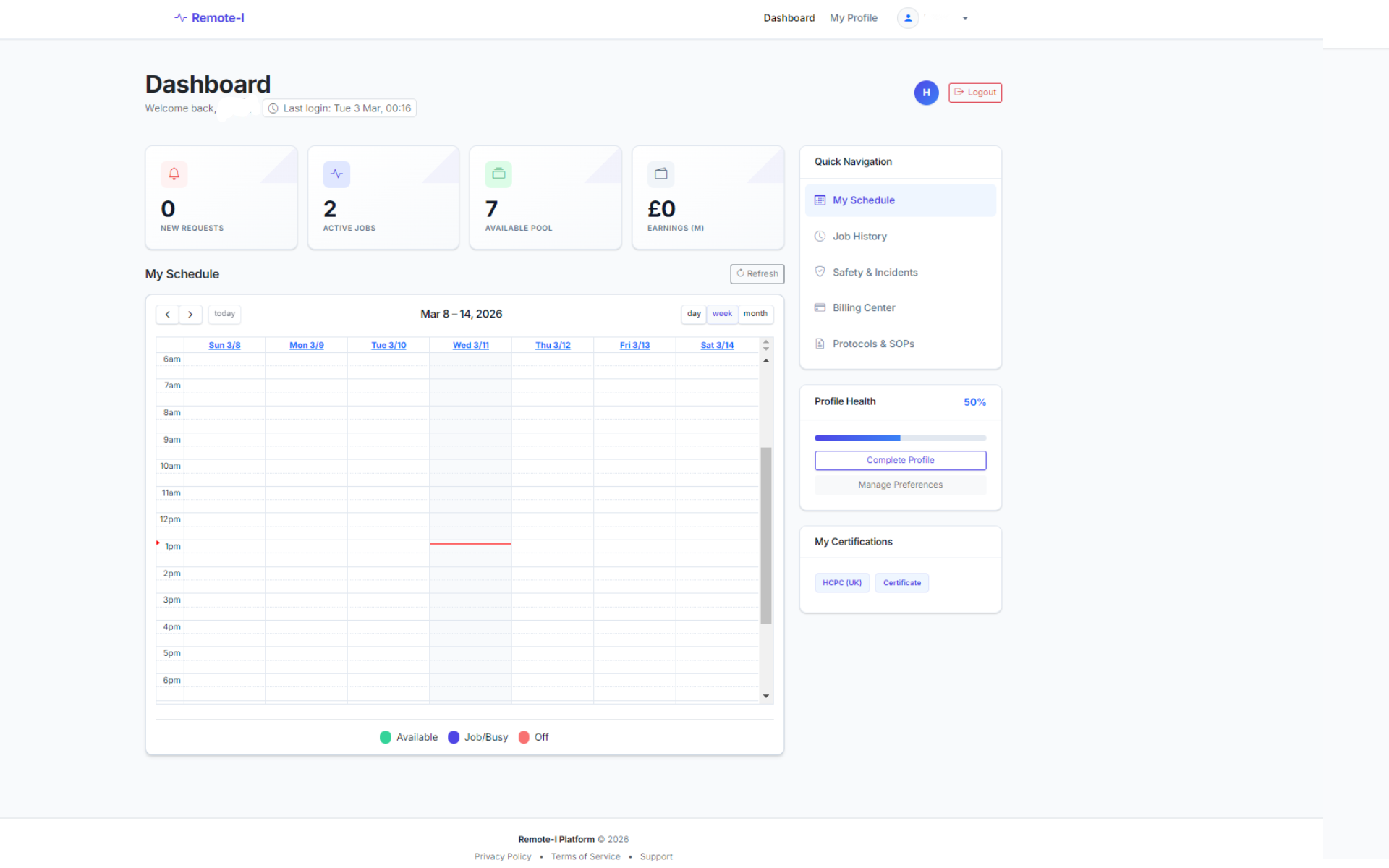
You already run on a flexible workforce — Remote-I lets you see it, deploy it, and
prove every radiographer was suitable for the shift they worked.
The proof you already assemble by hand, built in as the work happens. Coordination and governance for the bank, agency and locum cover you rely on now.
Not a staffing agency. Not a marketplace. We don't place or employ radiographers.
Finding cover still runs on phone calls and texts.
When a gap opens, someone rings round and texts a list. The department carries a flexible bench — bank, agency, locum — but no shared view of who's free, where, with what current skills. 76% of departments employ agency staff.
The work gets done. But the proof that each radiographer was suitable for that shift lives in inboxes, PDFs and someone's memory — until an inspector, or an incident review, asks for it cold.
UK trusts already spend £325M a year on temporary radiology cover. The governance burden rides on top of every pound of it.
Picture where imaging is heading — still early, but the direction is clear. A patient doesn't attend. Instead of two idle hours, that freed radiographer supports a short-staffed site across the network — work that's physically impossible today.
That's the future Remote-I is built for. The governing layer has to be there before the shift arrives — not bolted on after.
Remote, multi-site operation is still emerging. But when it scales, a redirect across sites is only safe if suitability is verified before the moment passes. Build the governing layer ahead of the wave and the shift arrives governed. Wait, and it arrives with none.
C · Why now
A system that captures sudden availability has to verify suitability faster than the moment passes — or it's just adding speed to risk.
That's the future's safety problem — but a version of it is already your problem now. Today, when you bring in flexible cover, the checks happen — but they live in separate systems, done at different times, by different people, and nothing ties them to the radiographer you actually put on the session.
Remote-I holds them together. Registration and credential documents are recorded against the radiographer — held with expiry dates and surfaced to the hospital, whose HR Manager or Lead Radiographer verifies them; the platform holds the record, the hospital owns the check. Modality competency is verified against a skill matrix and enforced at the point of matching. References are captured and confirmed, a minimum of two for external cover. CPD is recorded as the radiographer works. And every allocation is timestamped and audited — who was assigned, when, by whom.
So the record is built as the work happens, not reconstructed afterwards. That's the gap Remote-I closes today — and the same governing layer is ready for the shift that's coming.
D · The platform
Coordinate and govern the flexible workforce you run today.
Remote-I lets imaging departments see their flexible workforce, deploy it, and keep a record that proves every radiographer was suitable, eligible and accountable for the shift they worked. It earns its place on the bank-and-agency reality you run now.
And it's the same governing layer the move to remote, multi-site operation will need.
1.8M
Patients waiting
Patients waiting for a diagnostic test in England — up 190,000 in just 12 months.
NHS England, Jan 2026
83%
Can't staff a scanner
Of NHS clinical directors say they cannot staff an additional fully-funded CT or MRI scanner — due to lack of radiographers.
Royal College of Radiologists, 2024
£325M
Temporary staff spend
Spent by NHS trusts on temporary radiology staff in 2024 — projected to reach £547M within five years.
RCR Workforce Census, 2024
19.4%
CT vacancy rate
CT radiographer vacancy rate — an all-time high. MRI vacancies at 17.4% and rising year on year.
ASRT Staffing Survey, 2025
03 · Shortage
The shortage is structural, and worldwide.
This is why departments lean on flexible cover — and why it won't go away. Every market Remote-I operates in faces the same bottleneck: more scanners than operators, and no fast fix on the horizon. The numbers come from the regulators and professional bodies of each jurisdiction — they agree more than they disagree.
Global shortage data
1 / 8
🇬🇧 United Kingdom
83%
Of NHS clinical directors say their hospital cannot staff an additional fully-funded CT or MRI scanner — due to lack of radiographers to operate it.
Royal College of Radiologists Workforce Census, 2024
🇬🇧 United Kingdom
£325M
Spent by NHS trusts on temporary radiology staff in 2024 — equivalent to 2,910 consultant radiologist salaries. Projected to reach £547M within five years.
RCR Workforce Census, 2024
🇺🇸 United States
19.4%
CT technologist vacancy rate in 2025 — an all-time high. MRI vacancy rates rose to 17.4%. Both Remote-I's primary modalities.
ASRT Radiologic Sciences Staffing Survey, 2025
🇺🇸 United States
3×
The radiographer vacancy rate tripled in just three years — from 6.2% to 18.1%. Over 8,700 MRI technologist positions are currently open across the country.
ASRT, 2023 · Glassdoor, Apr 2026
🇪🇺 European Union
45%
Of Europe's radiologists and radiographers are over 51 years old. A retirement wave is compounding the shortage faster than training pipelines can replace them.
EU-REST Study, Insights into Imaging, 2025
🇩🇪 Germany
World #1
Germany performs more MRI exams per capita than any other European country — while facing the same structural radiographer shortage as the UK.
Europe's Looming Radiology Capacity Challenge
🇦🇺 Australia
87%
Of Australia's radiology workforce is in metropolitan areas — while 30% of the population lives regionally or rurally. Geographic maldistribution leaves entire regions unstaffed.
PMC / RANZCR Radiologist Shortage Study
🌍 Global
80%+
Of health systems worldwide are reporting staffing challenges in their radiology departments. WHO projects a shortfall of 18 million healthcare professionals by 2030.
Collective Minds Health, 2025 · WHO
🇬🇧 UK · Waiting list
1.8M
Patients waiting for a diagnostic test in England — up 190,000 in 12 months.
NHS England, Jan 2026
🇬🇧 UK · Vacancy rate
10.5%
Average diagnostic radiographer vacancy across NHS trusts — persistent for years.
College of Radiographers
🇪🇺 EU · Below average
16/27
EU member states with radiographer numbers below the EU average of 127 per million.
EU-REST Study, 2025
🇸🇪 Sweden · Shortage
500
Projected specialist shortage within five years. MRI and CT volumes continuously exceed workforce growth.
Swedish National Board of Health
🌍 Global · Attrition
17%
Of newly trained UK radiographers leave the NHS within five years of qualifying.
Nuffield Trust, 2023
🇸🇦 Saudi Arabia
11.3%
CAGR for Saudi teleradiology market 2025–2033. New hospitals opening faster than they can be staffed.
Renub Research, 2025
Global shortage data
🇬🇧£325M — NHS spend on temp radiology staff, 2024
·
🇺🇸19.4% — US CT technologist vacancy rate, all-time high
·
🇩🇪 Germany performs more MRI exams per capita than any European country
·
🇦🇺87% of Australia's radiographers live in cities — 30% of population is rural
·
🇪🇺45% of European radiologists are over 51 — retirement wave incoming
·
🌍80%+ of health systems globally report radiology staffing challenges
·
🇬🇧1.8M patients waiting for a diagnostic test in England
·
🇸🇪 Sweden projects a shortage of 500 specialists within five years
·
🇬🇧£325M — NHS spend on temp radiology staff, 2024
·
🇺🇸19.4% — US CT technologist vacancy rate, all-time high
·
🇩🇪 Germany performs more MRI exams per capita than any European country
·
🇦🇺87% of Australia's radiographers live in cities — 30% of population is rural
·
🇪🇺45% of European radiologists are over 51 — retirement wave incoming
·
🌍80%+ of health systems globally report radiology staffing challenges
·
🇬🇧1.8M patients waiting for a diagnostic test in England
·
🇸🇪 Sweden projects a shortage of 500 specialists within five years
·
02 · Match
Filling a gap discharges a compliance liability, instead of creating one.
Every other option asks the hospital to fill the gap first, then assemble the paper trail afterwards. Remote-I treats the two as the same problem: the record is built as the shift is staffed, not generated later. The audit trail is a byproduct of how the match was made, not a report you produce before an inspection.
01
Qualified radiographers
Modality-aligned radiographers matched to your service scope. MRI for MRI sessions. CT for CT sessions. No generalists, no mismatches, no agency dependency.
02
Virtual cockpit access Roadmap
Secure remote operating environment layered onto existing hospital infrastructure — under active development with manufacturer and integration partners. Pilots today operate within the hospital's own remote access pathway; cockpit licensing forms part of the post-pilot scope.
03
Governance control
SOP gating, audit trails, and clinical accountability built into every session. Whether your inspector is CQC, DNV, or Joint Commission — every timestamp renders in your hospital's local timezone, automatically. CQC-ready evidence outputs included as standard from day one.
The platform, in three pillars
One platform. Three questions imaging managers answer every week.
Each pillar reflects a different question imaging managers have to answer — and a different stakeholder who asks for the evidence.
Pillar I · Operate
How do I run today's work?
Severity-scored live workflow. Ten clinical and operational factors recalculated every five minutes, ranking every gap by real urgency. Saved sites, job templates, forward scheduling, three-phase notification escalation, and radiographer handover.
Pillar II · Govern
How do I prove every decision was sound?
Pool eligibility gated by skill matrix and two-reference verification. Compliance state recorded at session acceptance. Distinct hospital roles plus a platform Owner, with MFA. Timestamped, attributable, append-only audit trail with an IP fingerprint — rendered in each hospital's local timezone.
Pillar III · Evidence
What do I show the people who ask?
Regulator-ready evidence pack (CQC Well-Led, DNV, Joint Commission) generated on demand from live session data. Operational report covering fill rate, mean time to fill, agency-vs-platform cost comparison. Three governance add-ons available in production.
05 · Path
A practical path to a governed flexible workforce.
Start with a defined pilot, not a transformation programme. Controlled scope, clear governance, measurable outcomes from day one — on the bank-and-agency staffing you already run.
1
Workforce & governance setup
Map your flexible pools, modalities and scanners, and the sign-off and escalation rules you already work to.
Pools and eligibility defined
Modality and scanner scope
SOP and escalation alignment
2
Coordinate the workforce you have
See who's eligible for what, and book flexible cover against modality, scope and session — in one place, not a phone tree.
Eligibility-aware booking
Session-based coverage
Less time on the phones
3
Governance built in
Suitability verified at booking; accountability, sign-off and the record captured as the shift is staffed.
Suitability checks at booking
Accountability boundaries
Audit-ready record
4
Evidence & review
Inspection-ready outputs and procurement reporting, generated from live data — not a pre-inspection scramble.
Sessions and coverage delivered
Governance-ready evidence outputs
Procurement and regulator outputs
The same setup is what extends to cross-site, remote-supported coverage as that model matures.
04 · Verify
What gets verified, modality by modality — against the local register that applies where the shift takes place.
Competency is jurisdictional. Each radiographer is verified against the registration that applies where the shift takes place — confirmed by the hospital's own HR Manager or Lead Radiographer, not a generic "international" badge. Remote-I does not transfer credentials across borders.
Modality 01
MRI
Supported — same verification and governance pathway; only the modality-specific competencies differ. For MRI: field-strength experience (1.5T, 3T) and sequence familiarity, with MRI safety sign-off. Verified against the local register that applies where the shift takes place: HCPC (UK), the applicable national register (per EU member state), ARRT (US), MRPBA/MRTB (AU·NZ).
Available
Modality 02
CT
Supported — same verification and governance pathway; only the modality-specific competencies differ. For CT: dose-optimisation familiarity per protocol and contrast-administration competency where applicable. Verified against the local register that applies where the shift takes place: HCPC (UK), the applicable national register (per EU member state), ARRT (US), MRPBA/MRTB (AU·NZ).
Available
Modality 03
PET-CT
Supported — same verification and governance pathway; only the modality-specific competencies differ. For PET-CT: radiopharmaceutical handling and ARSAC certification where applicable. Verified against the local register that applies where the shift takes place: HCPC (UK), the applicable national register (per EU member state), ARRT (US), MRPBA/MRTB (AU·NZ).
Available
Modality 04
PET-MR
Supported — same verification and governance pathway; only the modality-specific competencies differ. For PET-MR: combined MRI plus nuclear-medicine scope, with cross-modality logbook recency. Verified against the local register that applies where the shift takes place: HCPC (UK), the applicable national register (per EU member state), ARRT (US), MRPBA/MRTB (AU·NZ).
Available
★ Limited availability
Design partner programme.
We're selecting a small number of NHS trusts, EU hospital sites and equivalent partners to shape the coordination-and-governance layer with us — proving it against the flexible workforce they run today, and helping define how it extends as remote, multi-site operation matures. Design partners shape the platform, inform the governance model, and lock in preferential pricing.
Remote-I uses essential cookies to keep the platform running securely. With your consent, we also use analytics (Google Analytics) and marketing (LinkedIn) cookies. See our Privacy Policy.
Cookie preferences
Choose which cookies Remote-I may use. Essential cookies cannot be disabled.
Essential cookies
Session, CSRF, MFA, login security. Required, cannot be disabled.
Analytics cookies
Google Analytics — helps us understand how the site is used. No personal data shared.
Marketing cookies
LinkedIn Insight Tag — measures campaign effectiveness. No personal data sold.